Submission
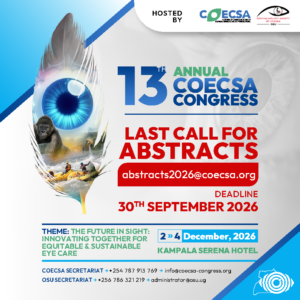
Abstracts must be submitted online to abstracts2026@coecsa.org
Deadline: 30th September, 2026
Eligibility & Scope
Abstracts must be original work and not previously published or presented at another major conference.
Abstract Structure
Maximum length: One A4 page, up to 400 words (excluding title), in MS Word format.
Title: Centered, in CAPITAL LETTERS, using Arial font. Should be clear and concise.
List surname followed by first name and initials, along with affiliations. Include the corresponding author’s email address. Underline the name of the presenting author and the corresponding author. Do not include degrees, titles, appointments, or addresses.
- Brief background: Brief context and state the problem or knowledge gap
- Aim/Objective
- Methods : Study design, Setting and population, Key methods and analysis.
- Results Main findings Include data where possible (numbers, percentages) Do not say “results will be presented”
- Conclusion/Recommendation.
Formatting Rules
English
Arial /12
Images, tables and graphs: Images are not permitted, as they do not reproduce well. Brief and clear tables or graphs are accepted (maximum of 1 page). This can be shared on a separate page. If the tables / graphs submitted exceed 1 page, those exceeding the limit will be excluded from publication. For poster presentations, images will be considered case by case.
Standard abbreviations may be used without definition. Non-standard abbreviations should be kept to a minimum and placed in parentheses after the first use of the word or phrase.
Supplemental materials are not required, but you may provide links or information sheets to fellow attendees.
Author Presentation & Policies Structure
The Scientific Committee will make every effort to accommodate all qualified abstracts within the program.
First Author: Usually limited to one or two oral presentations, but no limit on poster submissions.
- Registration: The presenting author must register for the congress and pay the full registration fee for the abstract to be accepted and included in the program.
- The abstracts will be apresented to a subspeciality session as deemed fit by the committee. The specialties include: Pediatrics and Strabismus, Vitreous and retina, Oculoplastics and Ocular Oncology, Anterior Segment (Uveitis, Cornea, Glaucoma, Cataract), Neurophthalmology, Community health and research, Business Entrepreneurship and Leadership.
COECSA 2026 ABSTRACTS
Ethical Considerations
Co-authors
Co-authors must agree with the results stated and have consented to be included as authors.
Disclosures
All participants must disclose any significant financial interest or other relationships they may have with the manufacturers of commercial products discussed in their presentations, panel or written materials. Also disclose any sponsors to the work being shared.
Clinical practice
COECSA will take it for granted that good clinical practice is observed in the conducting of all research. This applies especially to clinical studies involving patients and patient care and includes the understanding that the appropriate Ethics committee approval had been secured.
Copyright
The Congress Organisers & COECSA accept no responsibility for copyright infringements.
Presentation Types
Authors may indicate preference:
Oral presentation or Poster presentation
(Final decision made by the scientific committee)
Review & selection criteria
- Abstracts will be assessed on: Scientific merit , Relevance theme and to eye care in the COECSA region, Methodology quality, Clarity of results and conclusions
- Papers will only be accepted on the understanding that the main author or a co-author will personally present the paper
- Acceptance notifications will be emailed to the submitting author.